
Frequently Asked Questions
General
What is Learning on Demand?
Learning On Demand is subject-specific classes available 24 hours/day, when you want, on demand! They are broken down into three major groups: Capital Goods, Skill Mastery, and Resources. Capital Goods includes five major content areas: Parts Management, Service Management, Product Support Marketing, Product Support Selling, and Customer Service. Professional Development. Skill Mastery includes Electrical, Flatbed, Marketing, and Supply Chain Management. Resources include Podcasts, Blogs, Film Clips, Audio Clips, and Suggested Reading.
The Learning On Demand classes are a highly effective way to convey specific information in one aspect of your business, as either a refresher course for seasoned employees, part of an individualized employee development program or even an introductory program for newer hires.
What happens before, during, and after class registration?
Learning Without Scars has created an Online Education document that will guide you through the entire process from Registering to Purchasing Classes to taking Classes. We offer Certifications, Assessments, Job Functions Classes, Electrical, Flatbed, Marketing Lectures, and Supply Chain Management Lectures to meet your continuing education needs.
How do I create an account so I can purchase Education?
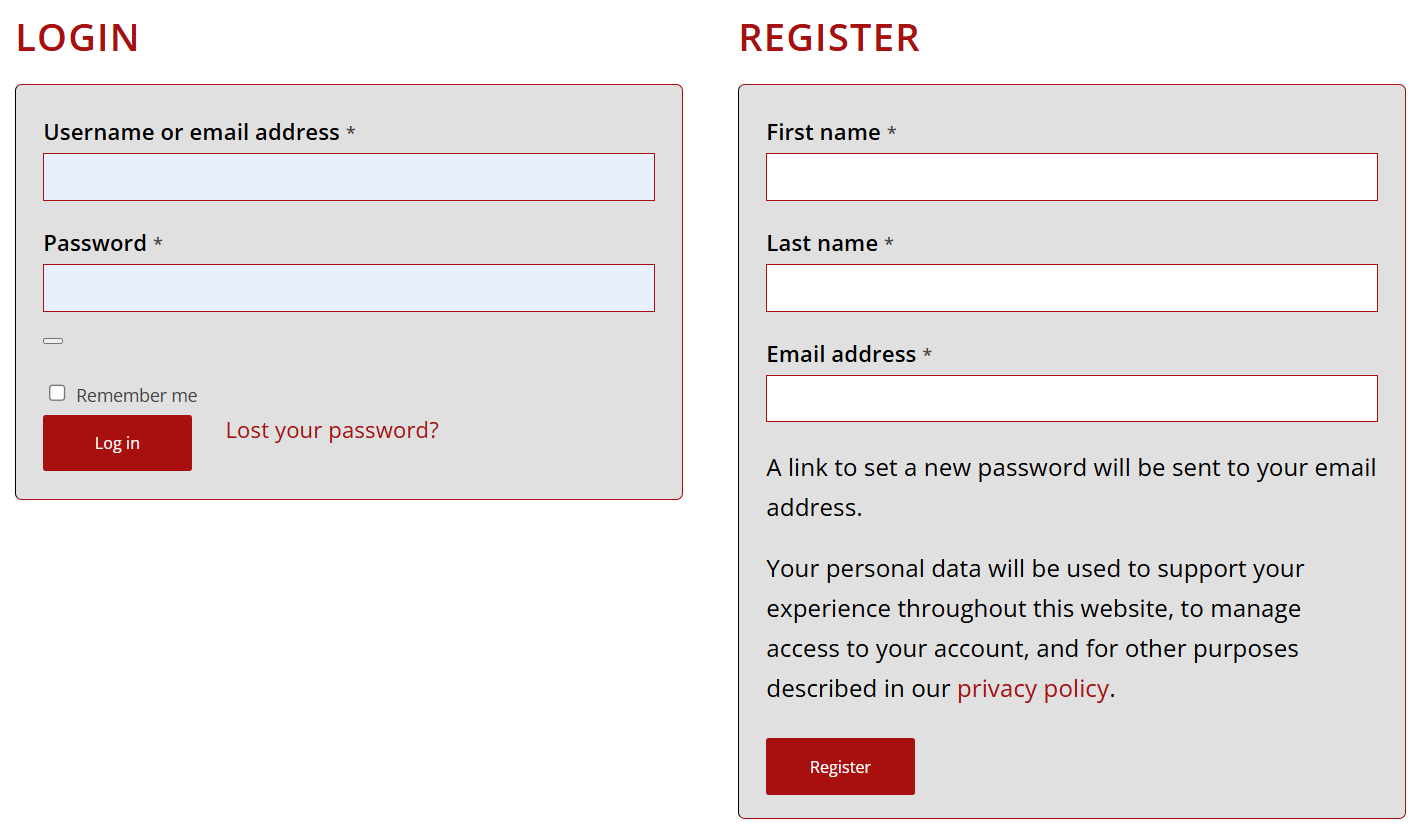
When you are accessing the system for the first time, it is recommended to get registered so you have an account to purchase assessments and classes from Learning Without Scars. To register, click on the bust icon to the right of the menu options.

You will be presented with the following screen. On the right side, fill in your first name, last name and email address; then press the Register button at the bottom.
How do I pay on Learning Without Scars?
During the purchase process, you will be prompted for your payment method on the Check Out page. We accept all major credit cards. See the Online Education document for more details.
Do you offer refunds?
For more information, please visit our Refund Policy page.
How does Learning On Demand work?
Our Learning On Demand programs offer the student rich content on specific subjects. These are excellent to fill in gaps for employee development, or as a refresher course for experienced staff. Our extensive library of learning products is available to individuals or businesses.
Capital Goods
How does the Capital Goods Skills Assessments work?
Our Capital Goods Skills Assessment are job function dependent. Each job function within Parts, Service, Product Support Selling, Product Support Marketing, and Customer Service has a specifically designed assessment. Each assessment consists of multiple-choice questions. The assessment score obtained will determine the skills and knowledge category for each student/employee.
How are the learning classes constructed?
Each Capital Goods class is made up of multiple segments as defined below:
Course Introduction
- Welcome Letter
- Student Class Overview
- Pre-Test
Course Segments
- Introductory Video
- Short Quiz
- Reading Document
- Long Quiz
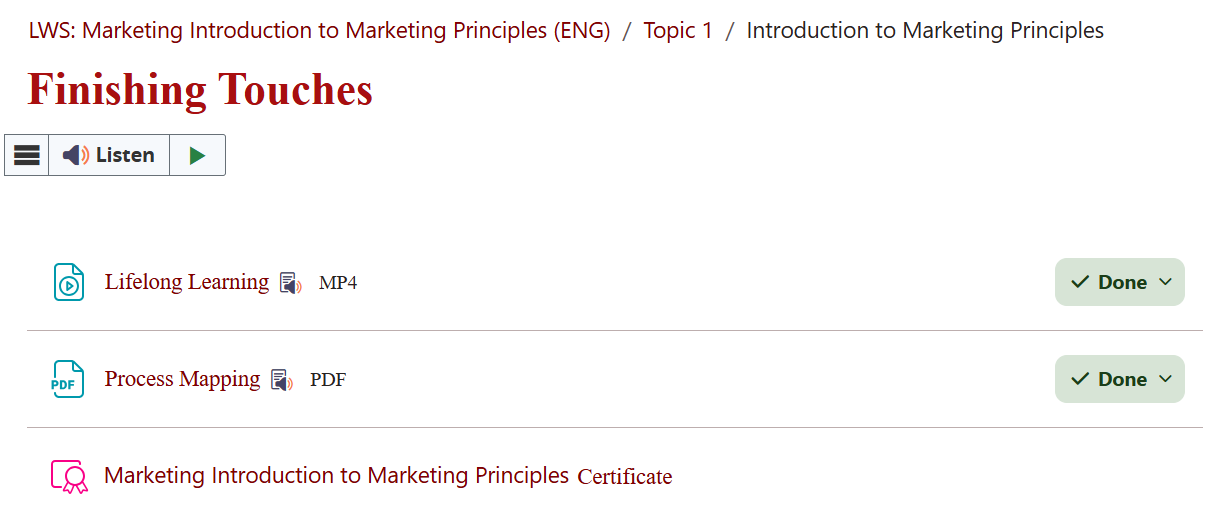
Finishing Touches
- Lifelong Learning
- Process Mapping
- Survey
- Feedback
- Course Certificate
How do I get my certificate?
When you have completed your class, your Certificate of Completion will be emailed to you.
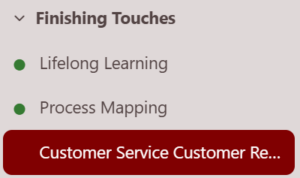
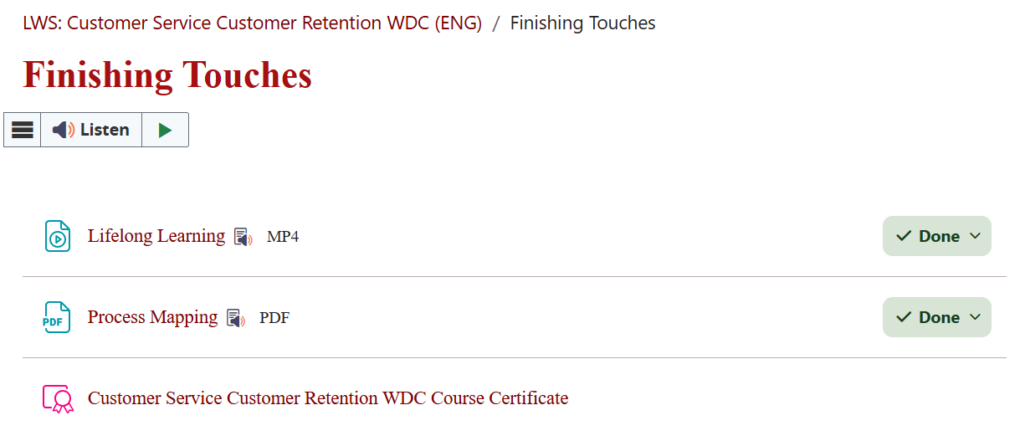
Should you lose your certificate, it will always be available in the Finishing Touches section of your completed class.
You can access the Finishing Touches section using either the pull out segments menu:
Or by scrolling to the bottom of the Course page and expanding Finishing Touches block.
Do you offer custom training programs or packages?
Most customers find our standard Assessments and Classes very suitable for their needs. However, we can develop custom training programs or curriculum for your unique needs. Get in touch with us and let’s discuss what you have in mind. Worst case, if we can’t help, we’ll try to point you in the right direction.
How do Certifications work?
The Certification process begins with a Diagnostic Assessment. Based on the score achieved on this assessment determine what you take next.
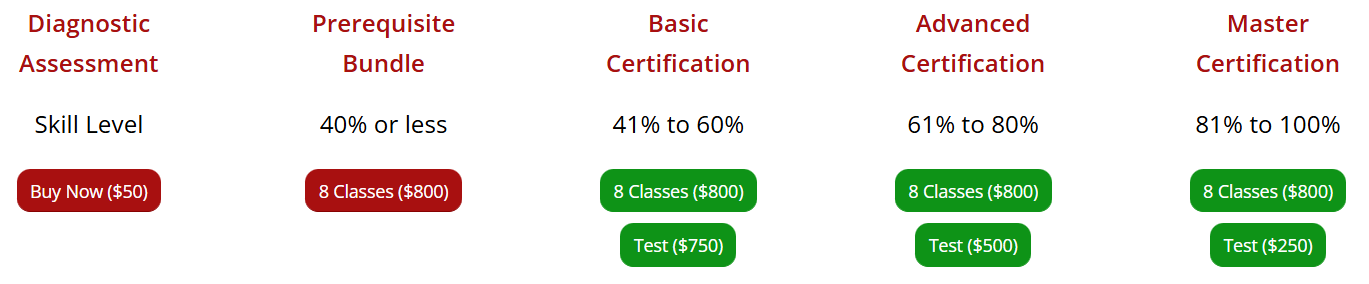
If you score 40% or less on the Diagnostic Assessment, it is highly recommended that you purchase the 8 class Prerequisite Bundle. Upon completion of these 8 classes, we suggest you take the Diagnostic Assessment again.
If you score above 40%, you can proceed with purchasing the 8 class bundle and test under the appropriate grouping based on which range your score falls into (Basic, Advanced or Master).
Electrical
How are the learning classes constructed?
Each learning program is made up of individual courses. Within each course, there are four components:
- A Reading List
- A pre-test to measure prior knowledge BEFORE taking the class
- The class video itself, with embedded surveys, questions and assignments
- A final test, with a minimum passing grade of 80%, to measure performance
- A survey
- A certificate
- An opportunity to provide comments
Once all components are completed in a course, you will have a certificate available.
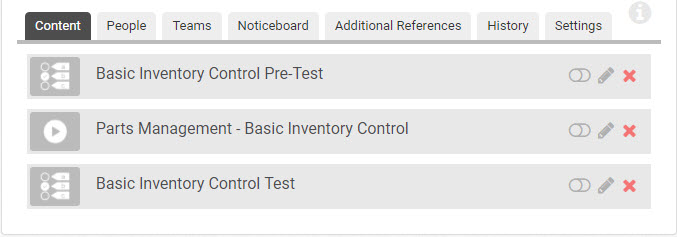
With each course, you will see the following 3 parts to the class when you have logged into your learning account.
Do I earn CEU’s for taking Electrical classes?
At this time, no CEU’s are issued for taking Electrical classes. Learning Without Scars is working through the necessary steps to hopefully allow you to earn CEU’s.
Flatbed
What is the purpose of Flatbed Assessments?
The flatbed assessments help to evaluate your current knowledge of cargo securement, safety practices, and applicable federal regulations in order to identify strengths and gaps. This allows you and your company to place you into the appropriate level of training, ensuring you receive targeted, relevant education rather than a one-size-fits-all approach. By establishing a baseline, the assessment helps improve training efficiency, supports compliance, and ultimately contributes to safer operations and reduced risk across the industry.
Do I get a certificate for taking a Flatbed class?
When you have completed your class, your Certificate of Completion will be emailed to you.
Should you lose your certificate, it will always be available in the Finishing Touches section of your completed class.
You can access the Finishing Touches section using either the pull out segments menu:
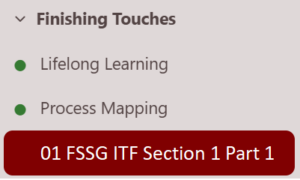
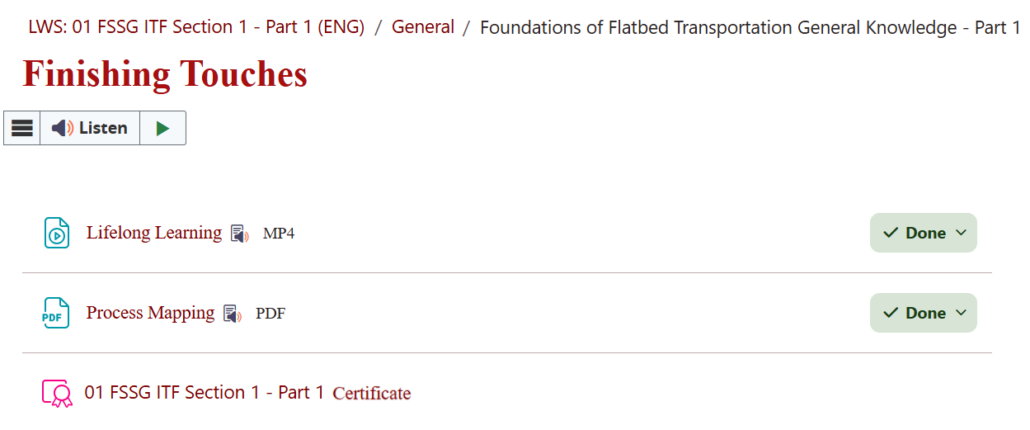
Or by scrolling to the bottom of the Course page and expanding Finishing Touches block.
What is flatbed trucking, and how does it differ from other types of trucking?
Flatbed trucking involves transporting freight on an open-deck trailer rather than inside an enclosed trailer. Because the freight is exposed and can vary greatly in size, shape, and weight, flatbed drivers must understand proper cargo placement, load securement, weight distribution, and protection from the elements. Common flatbed freight includes steel, lumber, machinery, pipe, building materials, coils, and heavy equipment.
How do I know how many straps or chains are required to secure a load?
No single number applies to every flatbed load. The number and type of tie-downs required depend on factors such as the cargo’s length, weight, configuration, the Working Load Limit (WLL) of the securement equipment, and whether commodity-specific regulations apply. Federal cargo securement requirements are primarily contained in 49 CFR Part 393, Subpart I. Proper flatbed education, such as the courses provided by Learning Without Scars through FSSG, teaches drivers how to determine the appropriate securement rather than relying on rules of thumb.
What is Working Load Limit (WLL), and why is it important?
Working Load Limit is the maximum load that a component of a cargo securement system is rated to handle during normal service. Drivers must consider the WLL of straps, chains, binders, anchor points, and other components when determining whether a securement system has sufficient capacity. Understanding WLL is essential because simply adding straps or chains does not necessarily mean a load is properly secured.
When should I use chains instead of straps?
The correct securement equipment depends on the freight being transported. Chains are commonly used for machinery, heavy equipment, steel, and other cargo where durability and resistance to abrasion are important. Web straps are commonly used for lumber, building materials, and freight that could be damaged by chains. Regardless of which is used, the securement equipment must have adequate WLL, be in serviceable condition, and be appropriate for the cargo and securement method.
How often should I inspect my load and securement after I start driving?
Flatbed securement does not end when the truck leaves the shipper. Drivers are required to inspect cargo and securement during transportation at specified intervals and should also recheck the load whenever there is reason to believe cargo or securement equipment may have shifted or loosened. Regular inspections allow drivers to identify loose tie-downs, shifted cargo, damaged equipment, or other problems before they become serious safety hazards.
Do I earn CEU’s for taking Flatbed classes?
At this time, no CEU’s are issued for taking Flatbed classes. Learning Without Scars is working through the necessary steps to hopefully allow you to earn CEU’s.
Lectures (Marketing | Supply Chain)
Do I get a certificate for taking a Lecture?
When you have completed your class, your Certificate of Completion will be emailed to you.
Should you lose your certificate, it will always be available in the Finishing Touches section of your completed class.
You can access the Finishing Touches section using either the pull out segments menu:
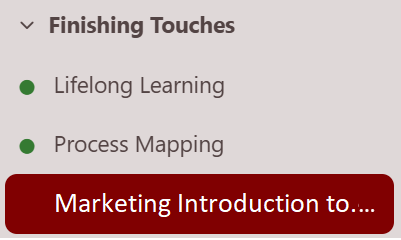
Or by scrolling to the bottom of the Course page and expanding Finishing Touches block.
Do I earn CEU’s for taking Lectures?
At this time, no CEU’s are issued for taking Lectures. Learning Without Scars is working through the necessary steps to hopefully allow you to earn CEU’s.