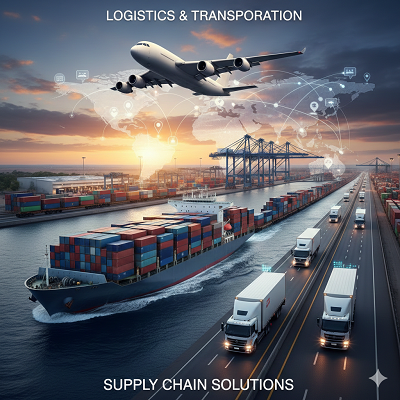
Logistics and transportation are the operational backbone of supply chain management, ensuring that goods and services flow seamlessly from suppliers to customers. These processes involve the intricate planning, implementation, and control of the movement and storage of goods, services, and information across the entire supply chain. Efficient logistics and transportation operations are critical for the smooth functioning of supply chains, ensuring that products are delivered on time, in the correct quantities, and in optimal condition. When properly managed, logistics and
transportation help companies meet customer demand, minimize operational costs, and enhance their competitive advantage in a global marketplace.
In today’s globalized economy, supply chains span multiple countries and continents. Companies source raw materials from different regions, manufacture them in various locations, and distribute finished products to markets across the globe. This global supply chain complexity has increased the need for effective logistics and transportation systems that can manage the flow of goods, information, and finances across different geographic regions. The ability of a company’s logistics and transportation network to efficiently manage these flows directly impacts its ability to meet market demand, maintain customer satisfaction, and achieve profitability.
One of the guiding principles of effective logistics and transportation management is adherence to the “Five Rights” of procurement and supply chain management:
ensuring that the right inputs are delivered in the right Quality, in the right Quantity, at the right Place, at the right Time, and for the right Price.
These “Five Rights” serve as a standard against which the success of logistics and supply chain operations can be
measured. They ensure that companies consistently deliver value to their customers while minimizing inefficiencies and costs within their supply chains.
The COVID-19 pandemic exposed significant vulnerabilities in global supply chains, causing disruptions in logistics and transportation worldwide. Companies that had agile and resilient logistics systems were better able to manage these disruptions and continue meeting customer demand. Conversely, companies that lacked flexibility in their logistics operations experienced significant delays, increased costs, and decreased customer satisfaction.
This lecture provides a comprehensive exploration of logistics and transportation in supply chain management, with a focus on the “Five Rights” and their role in ensuring the success of logistics operations. We will also discuss the different modes of transportation and how they impact cost and efficiency. Additionally, we will examine the key challenges faced by modern logistics systems, including capacity constraints, regulatory compliance, and environmental concerns.
Finally, we will explore emerging trends and technologies, such as autonomous vehicles, electric vehicles, and predictive
analytics, which are shaping the future of logistics and transportation.