Description
The modern supply chain is one of the most complex systems in business. It is global, multi-tiered, technology-enabled, and shaped by forces far beyond any single organization’s direct control. Companies depend on suppliers, logistics providers, ports, regulatory authorities, financial markets, labor forces, and digital platforms. This interdependence has delivered extraordinary efficiency and specialization. It has also created a reality where disruption is not an exception, it is a permanent feature of the operating environment.
Risk management in supply chains has therefore evolved from a narrow operational function into a strategic discipline. The objective is no longer merely to “respond” when disruptions occur. The objective is to build a supply chain that can anticipate, absorb, adapt, recover, and improve—without sacrificing the economic realities of cost, service, and competitiveness. Organizations that treat risk management as a compliance exercise tend to repeat the same cycle: disruption, emergency spend, customer failure, and reactive reconfiguration. Organizations that treat risk management as a capability create a durable advantage: they protect service levels, stabilize cost, preserve reputation, and earn trust in volatile markets.
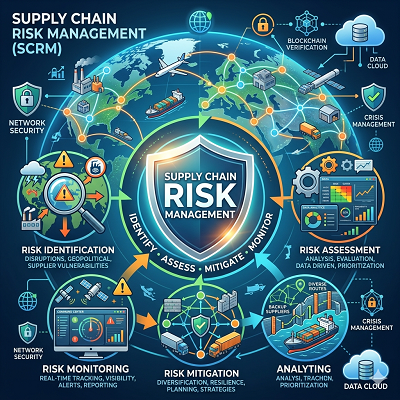
Supply Chain Risk Management (SCRM) is the systematic process of identifying, assessing, mitigating, monitoring, and governing risks that threaten supply chain continuity, performance, compliance, and strategic outcomes. Effective SCRM requires multi-tier visibility, cross-functional coordination, a disciplined measurement approach, and a supply network operating model designed for resilience—not just efficiency.
This lecture provides a comprehensive framework for supply chain risk management. It covers risk categories and how to identify them, practical mitigation strategies and how to execute them, governance and metrics, the role of technology and analytics, and common barriers to implementation. The overarching theme is this: supply chain resilience is not achieved through a single tactic. It is achieved through design choices—and those choices must be made intentionally.