


Ron SleeAs many of you know, Socrates has long served as our logo.

Socrates is remembered for his devotion to ethics, human behavior, and the care of the soul. Rather than lecturing, he professed uncertainty and pursued wisdom by questioning the assumptions of others. He taught through inquiry.

That has been my teaching style for more than 40 years. I ask questions rather than simply supplying answers because that approach helps students learn how to think for themselves. One of the most compelling aspects of Socrates’ philosophy is his belief that ignorance lies at the root of wrongdoing. In that sense, harmful actions often begin with a lack of understanding.

He is famously quoted as saying, “The unexamined life is not worth living.”

At Learning Without Scars, our purpose is to help people recognize their personal and professional potential. From that understanding, we create individualized learning paths that enable students to grow, succeed, and fully realize their capabilities.

As many of you understand, this is not easy work. It requires discipline, consistency, and above all, clarity about what we are trying to achieve.

I believe many of us have been taught obedience throughout our lives. It begins with parents trying to protect us and continues in school, where we are taught to read, write, and do arithmetic through prescribed methods. Yet when we compare outcomes internationally, the results are troubling. In the United States, only about 30% of students in grades 4, 8, and 12 perform at grade level in reading and arithmetic, even though we spend more per student than any other country in the world.

So perhaps the real issue is not what we teach, but how we teach.

My thinking leads me to a different model. Imagine every student spending the first day of the school year completing questionnaires and participating in interviews so the school can understand that student’s current skills and knowledge. Suppose we are all 10 years old and entering grade 3. On that first day, we completed a full assessment. If there are 40 students, they could then be placed into classes based on actual readiness, perhaps spanning material from grade 1 to grade 5. In that kind of system, students who need more support would not feel embarrassed, and those who are ahead would not be forced to wait while others catch up.

That is the same principle behind our comprehensive skills and knowledge assessments. We offer 20 assessments across five different departments, including general testing for technicians. While we do not teach repair or maintenance directly, we can accurately evaluate the skills required for those roles.

These assessments cover roughly 95% of the labor hours used in the capital goods industries, including products such as washing machines, lawn mowers, tractors, mining equipment, and many other forms of capital equipment. Traditional schools—whether technical schools, vocational schools, or universities—tend to teach individual subjects such as English literature or history. At Learning Without Scars, by contrast, we teach the operational aspects of the job. In the parts business, for example, we divide work into six distinct roles. We do the same in service, sales and marketing, customer service, and technician development.

Each assessment takes approximately two hours to complete. They consist of multiple-choice questions and, depending on the assessment, may include between 90 and 180 questions. Every assessment produces a score, and from that score we can design an individualized learning path to address gaps in a student’s skills and knowledge.

Each department and job function includes 32 classes organized into four groups of eight: Prerequisite, Basic, Advanced, and Master. These benchmarks are supported by more than 35,000 assessments conducted since 1994, giving them credibility, consistency, and strong industry relevance.

We designed this approach for employees in any company who fit the following categories:

  • Employees who interact with customers
  • Employees who lead people or manage assets
  • Technicians involved in repair, maintenance, or rental operations

I view personal development and lifelong learning very simply: I ask people to invest 90 minutes each week in their personal and professional growth. That adds up to 78 hours a year. Compared with roughly 2,080 working hours annually, it amounts to less than 4% of the time we devote to our jobs. It is a modest investment with the potential for an enormous return.


And yet, even that small commitment can be difficult. I understand that struggle because I face it myself. Balancing work and personal life is never easy, and it becomes even more demanding when family responsibilities are involved. Even so, there is joy in striving for that balance.

With this blog, I hope to encourage you to think more deeply about how you live and how you learn. Our blogs, podcasts, and newsletters are all designed to provoke reflection. We can offer ideas, but we cannot dictate your priorities. Only you can decide what matters most. In my view, lifelong learning should be near the top of that list.

The time to begin is now.
“In God we trust. All others bring data.”  (W. Edwards Deming)

Here’s how it works today. The share chart goes up at the quarterly review. If it ticked up, everyone relaxes. If it ticked down, someone gets a talking-to. Either way, the meeting ends without a single account named.
Market share is the number OEMs and dealers report and no one can act on. You cannot sell “share.” Worse, most turn to UCC (uniform commercial code filings, or “public liens”) to see what their competitors are selling, the one source that over-counts the smallest companies and individuals and misses most of the real buyers. Use that file to find prospects and you are working harder, not smarter. Never lean on it to track a competitor’s true activity.

Trust that comforting number and it will quietly mislead you. Share can climb while you lose ground. In one territory, the industry grew about 45% in a single year while the dealer’s share fell from 22 points to 14. And you only ever see the deals you won, never the ones you lost, so the one thing you most want to know, the share you are truly winning, is the one thing the scoreboard cannot show you.

Market share is coverage × close.

(The math is simple. Market share is the units a brand sells divided by the units the whole industry sells, measured one category of equipment at a time, such as wheel loaders.)

Coverage is the share of the right buyers you actually reach. Close is how often you win them once you do. Move either one and market share moves with it.

Two divisions of the same dealer can post nearly identical share and have opposite problems. One covers barely a third of its market but closes almost everything it quotes. The other blankets the territory and closes almost nothing. One needs breadth. The other needs depth. You cannot see either in a share figure, and the fix is worth real money.

Run it forward and it stops being abstract. A single point of share turns out to be only a few more machines a month, reachable by widening coverage in the counties you under-quote, not by hiring. The number you could never act on becomes a short list of specific moves.

Now imagine every rep opening a weekly list of the accounts you’re not yet covering, ranked, with the reason each one matters, and being measured on whether coverage widened, account by account, instead of on a lagging number they can’t touch. That is the difference between reporting the past and directing the present.

Market share is also the language the whole industry shares. The OEM building the machine, the dealer selling it and the rental company renting it are all working toward one end: serving the contractor well enough that the contractor wins, and comes back. Coverage and close are simply how each of them earns that share, one account at a time.

BiltReady makes it real. It turns market share into a number you can actually measure, won plus lost over the whole industry, with a step that finally captures the deals you used to lose in silence. For every named account it also puts a dollar figure on the prize: the total fleet value, and the opportunity in new-equipment sales, rental, and parts and service. Nothing else quantifies all three, and the numbers are built by data scientists and proven against real outcomes. Coverage becomes the leading indicator you take to leadership. The leverage is in aiming at the right buyers rather than the most familiar ones: in our analysis, the same effort pointed through BiltReady converts to a closed deal four to six times as often. And the math gets concrete. About a point of share is a few more units a quarter per division, with no new headcount.

Market share tells you what already happened. Coverage and close tell you what to do Monday morning.

No Opportunity Left Behind.


BiltData.ai analyzes 100M+ transactions to keep construction equipment OEMs, dealers and rental companies in the path of growth. Different links in one chain, united by a single goal: to serve the contractor in a way that lets them succeed. BiltReady, our quantitative buyer-signal model, surfaces what UCC filings miss. Forward-looking, named-account opportunities at the firms with real spend, scored by buyer probability and a quantified dollar opportunity across new-equipment sales, rental and parts and service, with quarterly timing per account.

“In God we trust. All others bring data.”  (W. Edwards Deming)

Picture your best salesman. He works on a black book, the names he has called for years, the dozen accounts he trusts, and he fills the rest of the week with instinct. Nobody is loafing. The effort is real. The problem is the map he was given.

Every dealer sells new iron off roughly the same list: the UCC financing file. It feels prudent because everyone uses it. That is exactly what makes it the most expensive habit in the building. Because every dealer pulls the same financed names, your reps spend the week elbowing rivals for the same handful of accounts, while the operators who quietly run the largest fleets, and finance the least, never surface at all.

Start with the belief we are trained in most deeply: that a customer is a customer. The data says otherwise. In the fleets we have analyzed, about one buyer in five drives roughly three-quarters of the value. The rest is a long, thin tail, and a few of those accounts actually cost you money to serve.

Now hold the financing list up against that truth, and watch it invert the market. The overwhelming majority of those filings come from the smallest firms in your territory, the ones that buy the least; four in ten don’t match a real operating business at all. The file doesn’t just miss the market. In practice, it points to your best people at the wrong end of it.

Picture the opposite. Every Monday, each rep opens a short, ranked list of named accounts most likely to buy a machine next, scored by the fleet they run, their probability to buy, and the aging competitor iron they’re due to replace. The contact is there. The reason is there. The rep walks up to the door already knowing what’s behind it.

And he’s measured on something honest: not activity nobody can verify, but whether the list got worked. That is the precise opposite of a week built on a hunch off a file every rival also holds.

None of this is really about one rep, or even one dealer. The manufacturer who builds the machine, the dealer who sells it and the rental company who put it to work are all chasing the same thing: the right iron in a contractor’s hands at the moment it helps them win the job. Point the whole chain at that, and the market share looks after itself.

That list is BiltReady. In place of the financing file, it hands each rep a scored set of named accounts, everyone carrying its total fleet value, its probability to buy, and the dollar opportunity quantified across the three ways a dealer earns: new-equipment sales, rental, and parts and service. Nothing else puts a number on all three. The scores are built by data scientists and proven against real outcomes.

A new equipment sale was never evenly distributed across the market. The standard list only made it look that way.

Stop selling to the wrong third. It’s not magic, just math.


BiltData.ai analyzes 100M+ transactions to keep construction equipment OEMs, dealers, and rental companies in the path of growth. Different links in one chain, united by a single goal: to serve the contractor in a way that lets them succeed. BiltReady, our quantitative buyer-signal model, surfaces what UCC filings miss. Forward-looking, named-account opportunities at the firms with real spend, scored by buyer probability and a quantified dollar opportunity across new-equipment sales, rental and parts and service, with quarterly timing per account.

A Paper by C. Lustgarten in the Shingo Institute

It’s a well-known paradox that meaningful change requires confronting difficult truths. Josh McEwan, Director of Manufacturing Product Development at O.C. Tanner, meets this idea head-on. “There is a lack of good leadership in the world,” he says. “There’s a lot of leaders out there, but I think really good leaders…there’s a few of them.”

He isn’t wrong. According to a recent Gallup survey, only 19% of employees in the U.S. strongly agreed with the statement “I trust the leadership of this organization”, and only 16% said that their organization’s leaders “inspire enthusiasm about the future”. Meanwhile, even as perceptions of leadership effectiveness are decreasing, the bar for good leadership is rising, necessitating development efforts that bring leadership intent into alignment with employee experience.

At the core of this leadership gap is a principle that is both commonly referenced and frequently misunderstood: respect. In the Shingo Model, Respect Every Individual is one of two principles in the Cultural Enablers dimension, the focus of which is the foundation of an organization: its people. The importance of respect in the workplace is undeniable. Not only do most people cite feeling respected as a primary need at work, but a lack of respect may indicate the presence of “ethically and legally questionable behavior”. However, while most people understand how important it is to show and receive respect, fewer seem able to articulate what this means in practice.

Start As You Mean to Go On

If respect were only about intent, it would be easy to demonstrate. But respect isn’t defined by what someone means to communicate, it is defined by what people experience.

At O.C. Tanner, such experiences are an embedded practice. Beginning on day one, employees are made to feel a part of the organization. Josh describes his first day at the company: he arrived to find his cubicle clean, his desk set up, his cell phone charged, and his name badge pinned to the wall. The effort put into making sure everything was ready to go had a profound impact, not only on Josh’s own sense of belonging but on how he would treat others moving forward. This is how leadership behaviors cascade—what is modeled at the top is enacted by teams, embedded in routines, and ultimately reflected in the experiences of every employee. In this way—when principles are practiced by everyone, at every level, every day—a culture of excellence is shaped.

Designing With Intent

While kindness is critical, respect cannot be something that is only expressed through individual behaviors; it must be embedded in systems. If systems are designed well, they reinforce the behaviors they seek to promote. Over time, those behaviors become habits—and those habits are what define culture.

At O.C. Tanner, systems such as coaching, strategy deployment, and recognition play a critical role in shaping such behaviors. Team members participate in setting goals rather than simply working toward those set by leadership. This gives them a sense of ownership, which not only increases commitment but encourages a deeper investment in outcomes. Simply put, when individuals are given the opportunity to contribute ideas, lead discussions, and influence decisions, their level of engagement increases. When leaders offer guidance rather than rigid requirements, capability grows alongside confidence. When contributions are recognized in meaningful ways, trust and morale follow.

What is critical is understanding that this kind of engagement cannot be expected. It must be designed.

Leadership Responsibility

Leaders shape the conditions in which people work. They influence whether people feel safe contributing ideas, whether problems are addressed, and whether effort is acknowledged. They determine whether feedback is welcomed or avoided, and whether learning is continuous or limited.

To create such an environment, leaders must consistently ask questions that challenge the current reality: How can I do a better job? What might I be missing? They must seek feedback from individuals at all levels of the organization and remain open to perspectives different from their own. They must acknowledge any sense of entitlement and resist the temptation to feel that they have “arrived,” recognizing instead that leadership is an ongoing process of learning and adjustment.

They must also practice being present. By doing the work to understand what others are experiencing, leaders position themselves to remove barriers and create a more supportive environment. Importantly, effective leadership requires trust, and trust isn’t built through isolated actions; it requires sustained, consistent engagement.

When people experience such support, they don’t just adapt to a culture—they enhance it.

Simple ≠ Easy

While Respect for Every Individual is often considered a basic principle, in practice, it’s anything but.

Respect is revealed in tiny details and reinforced through large systems. It is tested in moments of discomfort and strengthened through reflection. And more than just intention, it requires the humility to not only to own the truth of the current state but a willingness to learn from it.

We don’t have to accept a world in which effective leadership is lacking—as Josh McEwan reminds us, “All of us need to step up.” Because when we consistently put principles into practice, we move beyond intention and into the kind of leadership that allows others to truly experience respect.

About the Author Cara Lustgarten.

As the Editor for the Shingo Institute, I provide editorial leadership and content governance, supporting the development, consistency, and integrity of all official materials. My work spans standard work documentation, assessment reports, workshop curricula and companion books, research-informed briefs, press releases, newsletters, and digital communications. Additionally, I created and manage a centralized system for authoritative source content and long-term governance. The core of my role involves turning complex frameworks, assessment criteria, and practitioner expertise into clear, usable content for diverse audiences. I work across the full content lifecycle, from conceptual development and structure through editing, alignment, and quality assurance, ensuring accuracy, coherence, and alignment with organizational standards.

My approach is deeply shaped by my background in higher education and applied linguistics. As an ESL specialist in an Intensive English Program, I designed curricula aligned with accreditation standards, supported multilingual learners, and collaborated with academic leadership to strengthen assessment and instruction.

In addition, I led cross-functional projects, pitched stories to media, and secured speaking opportunities that elevated institutional visibility. I’m skilled at managing competing priorities, building strong relationships, and providing thoughtful, responsive service to internal and external stakeholders.

Further, my experience as an IELTS examiner with Oxford International helped me develop a strong foundation in standardized assessment, calibration, and evidence-based evaluation. In parallel with my role at Shingo, I continue to work as an editor for academic researchers worldwide across disciplines. This ongoing work helps me maintain cultural literacy and reinforces the global perspective that I bring to organizational content, learning materials, and evaluative frameworks. I operate with a learning mindset, welcome feedback, and care deeply about education, workforce development, and social impact. I thrive at the intersection of standards, learning, and communication, supporting mission-driven organizations and individuals by ensuring content is clear, credible, and consistent.

A Paper by Nir Eyal

May 22, 2026

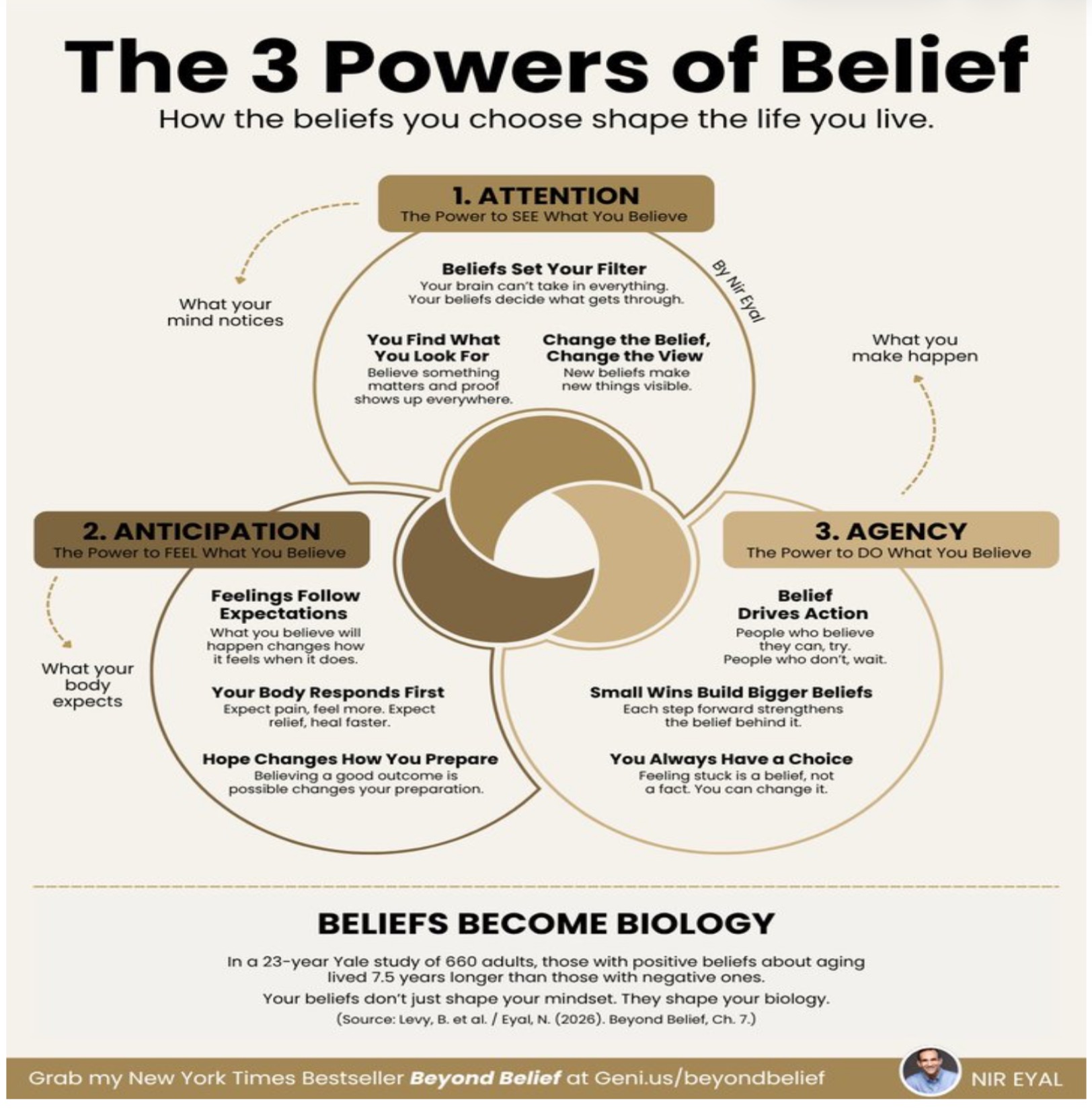
And the ones you hold about yourself shape three things more than almost anything else: what you notice, what you expect, and what you do.

I call them the 3 Powers of Belief.

1. Attention.

Beliefs filter what you see. If you believe willpower is a limited resource, you’ll notice every moment you feel “depleted.” Carol Dweck’s research found that signs of ego depletion only showed up in people who already believed willpower runs out. The belief produced the evidence, not the other way around.

2. Anticipation.

Beliefs shape what you expect next. If you believe distraction is something happening to you, you’ll keep waiting for the next interruption. If you believe it starts from within, you start looking for the discomfort you’re trying to escape.

3. Agency.

Beliefs decide what you do. “I’m not a snacker” beats “I’m trying not to snack.” Vegetarians don’t debate bacon. Identity closes the question before willpower has to open it.

The useful move isn’t to chase truer beliefs. It’s to ask whether the belief you’re holding is doing the work you need it to do — and if it isn’t, to swap it for one that does.

Beliefs are tools. Pick better ones.

NIR EYAL

New York Times bestselling author of Beyond Belief, Indistractable, Hooked | Keynote speaker on behavioral science, focus, and belief | Former Stanford Lecturer | Featured in NYT, HBR, CNN, Time 🧠