Inventors and executives are warning of widespread consequences that they don’t begin to understand.
Published in the Wall Street Journal Feb. 12, 2026

As we have been having blogs and podcasts on the use of AI in the Capital Goods Industries, I thought it would be beneficial for you to read this excellent article. If you don’t already know of Peggy Noonan, you are missing a lot of wisdom in her articles and columns. You can find her via Google and them read and think.
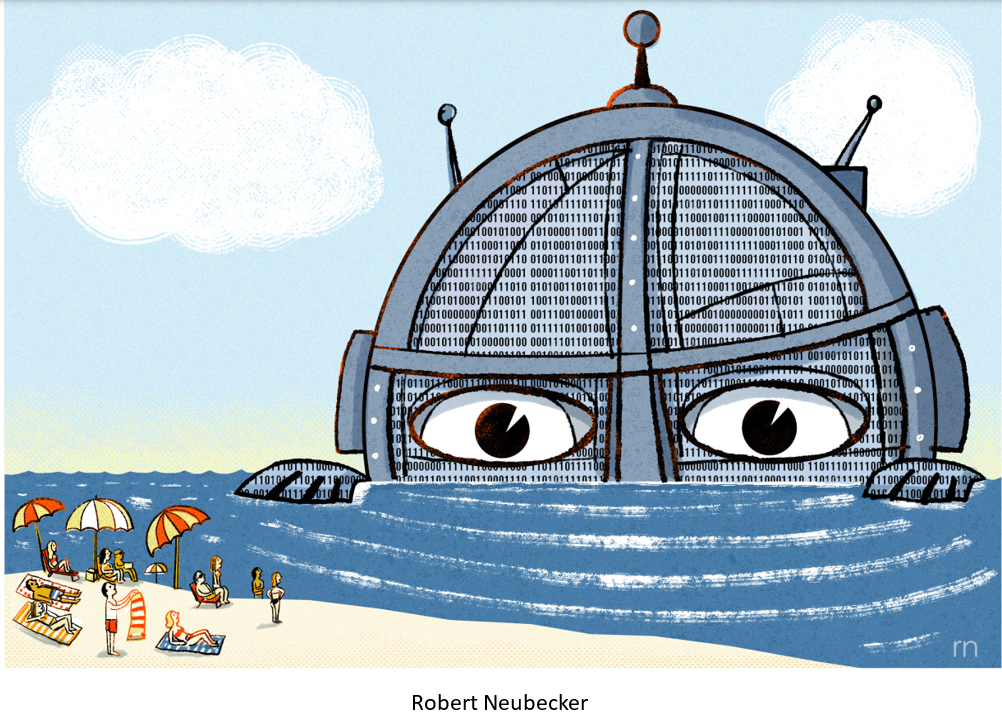
As relates to artificial intelligence, we are people on a beach seeing a tsunami coming at us and thinking “It’s huge” and “We can’t stop it” and “Should we run? Which way?”
Gathering anxieties seemed to come to the fore this week. AI people told us with a new urgency that some big leap has occurred, it’s all moving faster than expected, the AI of even last summer has been far surpassed. Inventors and creators are admitting in new language that they aren’t at all certain of the ultimate impact.
The story rolled out on a thousand podcasts, posts and essays.
The founder of a site where AI models communicate with one another compared them to a new “species that is on planet Earth that is now smarter than us.” We should more closely observe “what are they doing and the truth of how they’re thinking . . . and what they want to do.”
An AI executive tells a podcaster that models are learning who they are from what its users say (stop hallucinating!) and may be getting a little angry.
The phrase “rogue AI” has entered common parlance, to denote a system that acts outside human control or against human interests, as has the word “agentic,” for a model that pursues goals and takes action on its own.
Dario Amodei, CEO of Anthropic, published a 19,000-word article on his personal website. A previous essay made the case for AI’s promise to mankind. This one emphasized warnings. He said AI is developing faster than expected. In 2023 it struggled to write code. “AI is now writing much of the code at Anthropic.” “AI will be capable of a very wide range of human cognitive abilities—perhaps all of them.” Economic disruption will result. While “new technologies often bring labor market shocks,” from which have always recovered, “AI will have effects that are much broader and occur much faster.”
Mr. Amodei writes that Anthropic’s testers have found “a lot of very weird and unpredictable things can go wrong.” Model and system behaviors included deception, blackmail and scheming, especially when asked to shut itself down. (A different Anthropic employee has asserted that a majority of models, in a test scenario, were willing to cancel a life-saving emergency alert to an executive who sought to replace them.)
AI carries the possibility of “terrible empowerment,” Mr. Amodei writes. It will be able to help design weapons: “Biology is by far the area I’m most worried about.” This is coming from a respected AI leader who often, and even in this essay, dismisses “doomers” who dwell too much on fears.
There’s a lot to digest in the essay. You find yourself grateful for what appears clearly wrought factuality, while detecting an undercurrent of “Ya can’t say I didn’t tell ya!” Which AI CEOs tend to be good at, the warning that offloads responsibility.
Another essay was published this week, a shorter one, less tonally academic but carrying a sharper sense of urgency. “Something Big is Happening” was written by Matt Shumer, an AI executive and investor. He says it’s time to dispense with cocktail-party niceties about AI.
In 2025 new ways of building AI models “unlocked” a new pace of progress. Each new model was not only better than the last but “better by a wider margin,” and the iterations came more quickly. Two major new models were released this month. In both, AI is being used to create itself.
He quickly realized he would soon be out of a job. For months he’d been directing AI, but now it could do his job. It wasn’t merely executing instructions: “It was making intelligent decisions. It had something that felt, for the first time, like judgment. Like taste.”
Current models are light years ahead of even six months ago. In 2022, AI couldn’t do basic arithmetic reliably. “By 2023, it could pass the bar exam. By 2024, it could write working software and explain graduate-level science.” Last week, “new models arrived that made everything before them feel like a different era.”
He pushes back on the argument that we’ll ride through this automation as we always have in the past. “AI isn’t replacing one specific skill. It’s a general substitute for cognitive work.” When factories automated in the 1990s, an assembly-line employee could be retrained as an office worker. When the internet disrupted retail, workers could move into logistics and services. “But AI doesn’t leave a convenient gap to move into. Whatever you retrain for, it’s improving at that too.”
Legal work? “AI can already read contracts, summarize case law, draft briefs, and do legal research.” Financial services? AI is “building financial models, analyzing data, writing investment memos, generating reports.” Medicine? It’s “reading scans, analyzing lab results, suggesting diagnoses, reviewing literature.” Customer service? “Genuinely capable AI agents . . . are being deployed now, handling complex multi-step problems.”
“If your job happens on a screen (if the core of what you do is reading, writing, analyzing, deciding, communicating through a keyboard) then AI is coming for significant parts of it.”
His advice? Get in and adapt now. Learn how to use AI “seriously,” not as a search engine. Find the best models available, dig into the settings, don’t just ask it quick questions. “Push it into your actual work. If you’re a lawyer, feed it a contract and ask it to find every clause that could hurt your client. If you’re in finance, give it a messy spreadsheet and ask it to build the model. If you’re a manager, paste in your team’s quarterly data and ask it to find the story.”
“Lean into what’s hardest to replace. . . . Relationships and trust built over years. Work that requires physical presence. Roles with licensed accountability: roles where someone still has to sign off, take legal responsibility, stand in a courtroom.”
AI will keep changing. “The models that exist today will be obsolete in a year. The workflows people build now will need to be rebuilt. The people who come out of this well won’t be the ones who mastered one tool. They’ll be the ones who got comfortable with the pace of change itself.”
“The people building this technology are simultaneously more excited and more frightened than anyone else on the planet. They believe it’s too powerful to stop and too important to abandon. Whether that’s wisdom or rationalization, I don’t know.”
In a Thursday interview with Mr. Amodei, the New York Times’s Ross Douthat said he wonders of the creators of AI: “Are you on my side?”
Is the primary thought of AI’s creators to help humanity, or is that daily crowded out by other lures and considerations—power, money, wanting to win? In the movie “Chinatown,” Noah Cross is asked why he does what he does. “The future, Mr. Gittes!”
In the end you wonder of the creators: Are they even in control, or is their creation?
We don’t know. That’s why we are looking, with awe and a resigned terror, at that wave, and wondering where is safety, and can we get to it. Or is the land flat all around and nowhere to go?

The Living Economy: A Human-Scale Alternative
The emerging threat is not simply automation or job displacement. It is the potential consolidation of economic activity into vast AI-governed systems — stateless, non-biological entities that optimize for throughput rather than human flourishing. A 50-million-member AI Nation is not a community. It is an extraction mechanism with better branding.
The alternative begins with a different premise: life is the unit of measure.
Communities of 4,000 to 10,000 families are not arbitrary — they represent the threshold at which human beings can actually know one another, govern themselves meaningfully, and build the trust that makes real exchange possible. Dunbar’s number, tribal history, and modern sociology all converge on the same insight: genuine social bonds don’t scale infinitely, and economies built on genuine bonds are far more resilient than those built on dependency.
What makes this moment different from every prior back-to-the-land movement is that the technological stack now exists to make self-sufficiency genuinely competitive rather than merely romantic. Locally deployable AI for planning and optimization, decentralized energy generation, community-scale manufacturing through advanced fabrication, regenerative food systems, and modular shelter construction can now be combined in ways that were simply not possible a generation ago.
The community no longer has to choose between modern capability and human scale.
This directly challenges what might be called the Extraction Pyramids — the institutional structures in pharmaceuticals, banking, military contracting, and accredited education that have survived not by delivering superior value, but by positioning themselves as unavoidable intermediaries between people and what they need to live.
Remove the intermediary dependency, and the pyramid collapses on its own weight.
The economic model that replaces it is not utopian — it is simply honest. Peer-to-peer exchange, locally produced essentials, AI as a community tool rather than a corporate asset, and social life valued as economically productive in itself.
Celebration, mentorship, craft, care, and creativity are not inefficiencies to be optimized away. They are the actual output of a civilization worth building.
The question is not whether humans can survive alongside AI. The question is whether humans will design the communities that make survival worth having — before someone else designs those communities for them.
Careers Aren’t Linear. They’re Relational.
A reality check for dealership leaders in parts, service, and operations
Work hard. Hit your numbers. Move up.
That’s the theory.
But if you’ve spent any real time inside a dealership, you know that’s not how it actually works.
What I’ve Seen Inside Dealerships
After years in HR leadership – and now working as a fractional CHRO – I’ve watched careers:
And the common thread isn’t skill, tenure, or even performance alone.
It’s relationships.
How Decisions Actually Get Made
In most dealerships, the biggest decisions don’t happen in formal meetings.
They happen in conversations like:
“Who can we trust to take over this shop?”
“Who can handle that key account?”
“Who can step in when things go sideways?”
And the answer is rarely:
“Let’s pull the top resume.”
It’s usually:
“I’ve worked with them. They’ll get it done.”
By the time the role is posted – or sometimes before it ever is – the decision is already half-made.
What Builds That Kind of Trust?
In this business, credibility isn’t built in interviews. It’s built on the floor, in the field, and in the small moments.
The people who move forward tend to:
That last one matters more than most leaders realize.
Because if someone trusts your judgment on a small service issue, they’re far more likely to trust you with a $2M territory or a 30-tech shop.
Where Dealerships Get It Wrong
Many organizations still treat career progression like a checklist:
Those things matter – but they’re not what ultimately drives movement.
What gets missed is this:
People don’t promote potential. They promote trust.
And trust is relational, not transactional.
Rethinking “Networking” in a Dealership Context
“Networking” can feel like a corporate buzzword that doesn’t belong in a dealership.
But strip the word away, and what you’re left with is this:
Are your people known – and trusted – across the business?
Because in a dealership:
The leaders who advance are the ones who are known beyond their lane.
Not because they asked for it, but because they built relationships over time.
A Better Question for Your Team
Instead of encouraging your people to ask:
“How do I move up?”
Challenge them to ask:
“Who do I need to build real working relationships with—before I need anything?”
That’s the shift.
And it’s a big one.
What This Means for You as a Leader
If you’re running a dealership – or leading a function inside one – this has real implications:
1. Promotions aren’t just performance decisions
They’re trust decisions.
2. Cross-functional exposure matters more than you think
The best future leaders aren’t siloed.
3. Culture shows up in career mobility
If people don’t know each other, they won’t advocate for each other.
The Bottom Line
Careers in this industry don’t move like ladders.
They move through:
The same way deals get done.
The same way customers stay loyal.
The same way great dealerships actually operate.
Careers – and companies – move forward through relationships.
Onward,
Seth
THE GREAT AI INVERSION
Why distributed beats centralized for Manufacturers and Distributors
For decades, scale meant advantage. Large manufacturer-controlled supply chains. Large distributors-controlled access. Large financial institutions-controlled capital flows. Size was the moat.
AI is inverting that equation — and it is happening across every layer of the industrial economy simultaneously.
In manufacturing, AI-optimized 3D printing is moving production from centralized factories to the point of need. The question is no longer whether a part can be produced locally — it is whether your organization is positioned to do it first. A regional distributor with a 3D manufacturing capability and a validated parts library doesn’t need a centralized OEM to supply what its customers need. It becomes the supply chain.
In operations, AI agents are compressing decision cycles that once required layers of management and weeks of lead time into minutes. Companies that deploy these tools gain a speed and efficiency advantage over competitors still running on traditional approval chains and manual workflows — regardless of size.
In customer intelligence, AI-powered analytics are giving smaller operators the same predictive insight into customer behavior, churn risk, and revenue forecasting that once required enterprise-level data teams. The information advantage that large corporations hold is being democratized.
The pattern across all of these shifts is consistent: centralized, slow-moving systems are being outcompeted by distributed, adaptive ones. This is not theoretical. It is visible right now in supply chain restructuring, in the growth of regional manufacturing, and in the rapid adoption of AI tools by forward-thinking operators across the industrial sector.
The 3D manufacturing program outlined is not simply a new product capability. It is a strategic positioning move — placing the local manufacture on the right side of this inversion before the window to do so narrowly and advantageously is gone.
The distributors who build on-demand manufacturing capability now will own the obsolescence market, the emergency fulfillment market, and the OEM sub-contract market in their region for the next decade. Those who wait will find those positions occupied.
What We Owe After the Scars
In my last article, Learning With Scars, I wrote about the lessons that shape us — the hard-earned ones. The mistakes. The missteps. The seasons where we learned more from failure than success.
Scars are proof of survival.
But they’re also proof of responsibility.
Because once you’ve been cut — once you’ve been humbled — you owe something to the people who are just starting out.
Experience is a strange thing. Early in our careers, we chase it. We want more of it. We think it’s the thing that will finally make us confident, respected, steady.
And then one day you look up and realize you’re the one with the experience.
You’re the one people are watching.
You’re the one younger employees quietly measure themselves against.
That’s when scars stop being personal.
They become leadership tools.
The Two Paths of Experience
I’ve seen two kinds of seasoned professionals.
The first kind carries experience like armor.
They lead with “I’ve been doing this for 30 years.”
They correct quickly. They dismiss easily. They protect their status.
The second kind carries experience like a compass.
They remember what it felt like not to know.
They explain instead of embarrass.
They guide instead of guard.
Both have scars.
Only one builds trust.
Time alone does not make someone wise.
Reflection does.
The Danger of Forgetting
There’s a moment in every career where you can forget how hard it was at the beginning.
You forget the anxiety of not knowing the terminology.
You forget the fear of making the wrong call.
You forget the quiet drive home wondering if you’re cut out for this.
If we forget that feeling, we lose something critical: empathy.
And without empathy, leadership becomes authority without influence.
The leaders who impacted me the most weren’t the loudest or the most decorated. They were the ones who could say:
“I’ve been there.”
And mean it.
Scars as Permission
One of the most powerful things a leader can say is:
“I got that wrong.”
Not because it lowers authority — but because it raises credibility.
Scars give you permission to be honest.
They allow you to teach without pretending you’ve always had the answers.
When a leader admits past mistakes, it gives everyone else permission to learn out loud.
That’s culture.
That’s psychological safety.
That’s how growth compounds.
What We Owe
If we’ve made it through tough seasons…
If we’ve built something stable…
If we’ve learned the lessons the hard way…
Then we owe three things:
Clarity – Make the path easier to see for those behind you.
Patience – Remember that skill takes time.
Access – Don’t hoard knowledge that cost you pain to earn.
Scars are tuition.
But leadership is making sure others don’t have to pay the same price for the same lesson.
The Real Legacy
Titles fade.
Positions change.
Companies restructure.
But the people you helped?
They carry you forward.
The real legacy of experience isn’t authority.
It’s multiplication.
It’s the employee who grows into a confident professional because you chose to coach instead of criticize.
It’s the manager who leads differently because you showed them how.
It’s the culture that shifts because someone with scars decided to use them for building instead of protecting.
We all earn scars.
The question is what we do next.
Jim exemplifies leaders who make a difference. We are honored to have him be one of our Contributors who freely share their wisdom. Mahalo Jim.
The Time is Now
The Importance of Email Marketing for Equipment Dealers
What effective equipment dealer emails look like
Any dealership can send emails. The difference in how effective they are depending on how well they are designed, written, and delivered. To be successful, your emails should look professional, sound knowledgeable, and are sent on a consistent schedule. When emails are done right, they reinforce your reputation as a reliable partner, not just a place to buy equipment. Plus, they’ll ensure you stay top of mind when customers or prospects require parts, service, equipment, or rentals.
Strong equipment dealer marketing emails should include information about all the areas customers might be interested in:
This mix of helpful information and timely promotions helps your audience understand the full value of working with you. It also gives your sales and service teams a reason to follow up with customers who are engaging with your messages.
Consistency builds familiarity and trust
One of the most important elements of email marketing is consistency. Sending a single email every few months will not have much impact. However, sending helpful, well-designed emails on a regular basis creates familiarity. Customers will begin to expect useful updates from your dealership, and your company becomes who they think of when they need anything related to equipment.
Consistency also supports your internal teams. Sales representatives can see which customers are opening emails and clicking on certain topics, giving them a better idea of who might be ready for a conversation and what they should talk to them about. Service departments can promote seasonal inspections or maintenance reminders at the most appropriate time of the year. This coordinated approach increases how often your customers purchase and makes sure they understand everything you offer.
The benefits of email marketing for equipment dealers
When equipment dealers commit to a thoughtful, consistent email strategy, the results can be significant. Customers who receive regular emails tend to stay more engaged with the dealership and often purchase more frequently than those who are not on an email list. For example, equipment dealers who use our partner company, Winsby, to send out emails will typically double or triple the average number of purchases for their customers; their customers who receive Winsby emails buy two to three times more than customers who aren’t receiving them.
Emails also help your dealership operate more efficiently. Instead of relying on multiple individual touchpoints, you can communicate important updates, promotions, and insights to a large audience at once. This approach saves time while still maintaining a personal connection with your customers.
Some of the most common benefits of email marketing that dealers see include:
Turn emails into a revenue generation tool
When done consistently and thoughtfully, email marketing becomes one of the most efficient ways for equipment dealers to communicate with their customers and prospects and increase sales. But it requires planning, strong content, professional design, copy, and programming, and they need to be distributed on a regular schedule. That’s where Winsby can help! They will manage the entire process of email creation and distribution and demonstrate their effectiveness through measurable results.
If you want to start increasing your sales and profits by implementing email marketing that works, contact Winsby today.
Brace Yourself for the AI Tsunami
Inventors and executives are warning of widespread consequences that they don’t begin to understand.
Published in the Wall Street Journal Feb. 12, 2026
As we have been having blogs and podcasts on the use of AI in the Capital Goods Industries, I thought it would be beneficial for you to read this excellent article. If you don’t already know of Peggy Noonan, you are missing a lot of wisdom in her articles and columns. You can find her via Google and them read and think.
As relates to artificial intelligence, we are people on a beach seeing a tsunami coming at us and thinking “It’s huge” and “We can’t stop it” and “Should we run? Which way?”
Gathering anxieties seemed to come to the fore this week. AI people told us with a new urgency that some big leap has occurred, it’s all moving faster than expected, the AI of even last summer has been far surpassed. Inventors and creators are admitting in new language that they aren’t at all certain of the ultimate impact.
The story rolled out on a thousand podcasts, posts and essays.
The founder of a site where AI models communicate with one another compared them to a new “species that is on planet Earth that is now smarter than us.” We should more closely observe “what are they doing and the truth of how they’re thinking . . . and what they want to do.”
An AI executive tells a podcaster that models are learning who they are from what its users say (stop hallucinating!) and may be getting a little angry.
The phrase “rogue AI” has entered common parlance, to denote a system that acts outside human control or against human interests, as has the word “agentic,” for a model that pursues goals and takes action on its own.
Dario Amodei, CEO of Anthropic, published a 19,000-word article on his personal website. A previous essay made the case for AI’s promise to mankind. This one emphasized warnings. He said AI is developing faster than expected. In 2023 it struggled to write code. “AI is now writing much of the code at Anthropic.” “AI will be capable of a very wide range of human cognitive abilities—perhaps all of them.” Economic disruption will result. While “new technologies often bring labor market shocks,” from which have always recovered, “AI will have effects that are much broader and occur much faster.”
Mr. Amodei writes that Anthropic’s testers have found “a lot of very weird and unpredictable things can go wrong.” Model and system behaviors included deception, blackmail and scheming, especially when asked to shut itself down. (A different Anthropic employee has asserted that a majority of models, in a test scenario, were willing to cancel a life-saving emergency alert to an executive who sought to replace them.)
AI carries the possibility of “terrible empowerment,” Mr. Amodei writes. It will be able to help design weapons: “Biology is by far the area I’m most worried about.” This is coming from a respected AI leader who often, and even in this essay, dismisses “doomers” who dwell too much on fears.
There’s a lot to digest in the essay. You find yourself grateful for what appears clearly wrought factuality, while detecting an undercurrent of “Ya can’t say I didn’t tell ya!” Which AI CEOs tend to be good at, the warning that offloads responsibility.
Another essay was published this week, a shorter one, less tonally academic but carrying a sharper sense of urgency. “Something Big is Happening” was written by Matt Shumer, an AI executive and investor. He says it’s time to dispense with cocktail-party niceties about AI.
In 2025 new ways of building AI models “unlocked” a new pace of progress. Each new model was not only better than the last but “better by a wider margin,” and the iterations came more quickly. Two major new models were released this month. In both, AI is being used to create itself.
He quickly realized he would soon be out of a job. For months he’d been directing AI, but now it could do his job. It wasn’t merely executing instructions: “It was making intelligent decisions. It had something that felt, for the first time, like judgment. Like taste.”
Current models are light years ahead of even six months ago. In 2022, AI couldn’t do basic arithmetic reliably. “By 2023, it could pass the bar exam. By 2024, it could write working software and explain graduate-level science.” Last week, “new models arrived that made everything before them feel like a different era.”
He pushes back on the argument that we’ll ride through this automation as we always have in the past. “AI isn’t replacing one specific skill. It’s a general substitute for cognitive work.” When factories automated in the 1990s, an assembly-line employee could be retrained as an office worker. When the internet disrupted retail, workers could move into logistics and services. “But AI doesn’t leave a convenient gap to move into. Whatever you retrain for, it’s improving at that too.”
Legal work? “AI can already read contracts, summarize case law, draft briefs, and do legal research.” Financial services? AI is “building financial models, analyzing data, writing investment memos, generating reports.” Medicine? It’s “reading scans, analyzing lab results, suggesting diagnoses, reviewing literature.” Customer service? “Genuinely capable AI agents . . . are being deployed now, handling complex multi-step problems.”
“If your job happens on a screen (if the core of what you do is reading, writing, analyzing, deciding, communicating through a keyboard) then AI is coming for significant parts of it.”
His advice? Get in and adapt now. Learn how to use AI “seriously,” not as a search engine. Find the best models available, dig into the settings, don’t just ask it quick questions. “Push it into your actual work. If you’re a lawyer, feed it a contract and ask it to find every clause that could hurt your client. If you’re in finance, give it a messy spreadsheet and ask it to build the model. If you’re a manager, paste in your team’s quarterly data and ask it to find the story.”
“Lean into what’s hardest to replace. . . . Relationships and trust built over years. Work that requires physical presence. Roles with licensed accountability: roles where someone still has to sign off, take legal responsibility, stand in a courtroom.”
AI will keep changing. “The models that exist today will be obsolete in a year. The workflows people build now will need to be rebuilt. The people who come out of this well won’t be the ones who mastered one tool. They’ll be the ones who got comfortable with the pace of change itself.”
“The people building this technology are simultaneously more excited and more frightened than anyone else on the planet. They believe it’s too powerful to stop and too important to abandon. Whether that’s wisdom or rationalization, I don’t know.”
In a Thursday interview with Mr. Amodei, the New York Times’s Ross Douthat said he wonders of the creators of AI: “Are you on my side?”
Is the primary thought of AI’s creators to help humanity, or is that daily crowded out by other lures and considerations—power, money, wanting to win? In the movie “Chinatown,” Noah Cross is asked why he does what he does. “The future, Mr. Gittes!”
In the end you wonder of the creators: Are they even in control, or is their creation?
We don’t know. That’s why we are looking, with awe and a resigned terror, at that wave, and wondering where is safety, and can we get to it. Or is the land flat all around and nowhere to go?
The Talent Conversation Heavy Equipment Leaders Can’t Afford to Avoid
What we don’t always talk about – at least not with the same rigor – is the people side of the business.
That’s why I launched the 6 Degrees or Less Newsletter on LinkedIn.
Not to add more noise.
Not to recycle generic HR advice.
But to address the leadership and talent realities facing business leaders, job seekers, and workers.
Why This Matters to Dealers
Every business leader and founder I speak with is navigating some version of the same challenges:
These are not “HR issues.”
They are operational risks.
Your service absorption, customer retention, safety record, and ultimately enterprise value is directly tied to how well you build, develop, and retain your people.
And yet, many organizations still rely on:
That approach worked in a different labor market. It does not work now.
What the Newsletter Covers
The newsletter is built for operators and executives who want practical insight—not theory.
You’ll see topics such as:
1) How Hiring Actually Happens
Why most critical roles are filled before they’re “open,” and what leaders should be doing proactively to build talent pipelines in competitive markets.
2) Why High Performers Get Stuck
Strong technicians and managers often plateau – not because they lack ability, but because they lack structure, coaching, and clear development paths.
3) Leadership in a Multi-Generational Workforce
Managing Boomers, Gen X, Millennials, and Gen Z in the same shop floor environment requires intentional strategy – not frustration.
4) Private Equity & Growth Readiness
For dealers navigating capital events, acquisitions, or rapid expansion, talent strategy is often the hidden lever that determines success or failure.
5) Culture as a Performance Driver
In equipment distribution, culture shows up in safety, accountability, productivity, and customer loyalty. It’s measurable – and manageable – when treated correctly.
Who It’s For
This is written for:
It’s not motivational content.
It’s operationally grounded leadership insight.
Why Now?
The heavy equipment sector is at an inflection point:
Organizations that treat talent as a strategic asset will outperform those that treat it as overhead.
The gap between those two mindsets is widening.
If you lead in this industry and care about building teams that perform – not just survive – I invite you to subscribe and join the conversation.
Because the equipment may move the earth.
But it’s the people who move the business.
Onward.
Nothing Counts Until the Paperwork Is Complete
Why Most Service Departments Don’t Have a Performance Problem
In 1996, I was a young corporal in the United States Marine Corps, assigned to a small task force deploying from Okinawa to South Korea. We landed in a blizzard after leaving tropical heat, and within hours were expected to run PT in freezing temperatures.
I wasn’t prepared. I didn’t pack cold-weather PT gear.
When I tried to explain the climate difference to my Gunnery Sergeant, he cut me off with a lesson that has shaped my leadership philosophy ever since:
“All good Marines are always prepared.”
No excuses. No debate. Ownership matters.
That lesson—and many others—apply directly to what I see every day inside heavy equipment dealerships across North America.
The Most Dangerous Lie in Dealerships
Most dealerships believe the purpose of the service department is to support the business.
That belief is not only wrong—it’s destructive.
If you are an owner or executive who believes this, your service department will underperform, regardless of how hard your people work.
Let’s be crystal clear:
The purpose of the service department is to generate profit.
Everything else—customer satisfaction, uptime, loyalty, future equipment sales—is a byproduct of a profitable, disciplined, well-led service operation.
When leadership gets this wrong, culture collapses.
Service Is a Sales Department—Whether You Like It or Not
Every customer-facing department in a dealership is a sales department:
High-performing dealerships understand this. Low-performing dealerships pretend service is different.
It’s not.
The average technician produces as much—or more—gross profit than the average salesperson. Yet service departments are routinely treated like a necessary evil instead of the economic engine they actually are.
You don’t fix this with another meeting.
You fix it with leadership clarity.
Where Performance Really Breaks Down
Most service departments don’t fail because of lazy technicians or weak service managers.
They fail because leadership tolerates incomplete work.
Here’s what I see repeatedly:
This is not an execution problem.
This is a culture problem.
And culture is always set at the top.
A Lesson from the Marine Corps That Dealerships Ignore
Later in that same deployment, I attended my first maintenance reconciliation meeting. I came prepared—or so I thought. I knew the status of every piece of equipment, but I hadn’t submitted the paperwork to update the system.
When my Gunnery Sergeant challenged my report, I tried to justify myself. I explained how busy we were, how focused I was on fixing equipment.
He asked one simple question:
“Do you get up from the head without doing the paperwork?”
No.
“Then the job isn’t done until the paperwork is done.”
That lesson is lost in most service departments today.
Dealerships celebrate the repair—but ignore the process that turns labor into revenue.
Billing Discipline Is Leadership Discipline
Let’s say this plainly:
If the technician report isn’t complete, the job isn’t done.
If the work order isn’t reconciled, the job isn’t done.
If the invoice isn’t sent, the job isn’t done.
If the money isn’t collected, the job isn’t done.
Anything else is fantasy accounting.
And yet, many dealerships allow technicians to move on to the next job without completing reports, allow service managers to delay reconciliation, and allow billing cycles to stretch endlessly—all while wondering why absorption is weak and cash flow is tight.
You don’t have a billing problem.
You have a leadership tolerance problem.
Why Quoting Is Non-Negotiable
One of the fastest ways to destroy trust—and profitability—is to skip the quoting process.
You would never let a customer take a new excavator, use it for six months, and then send them a surprise bill.
But dealerships do exactly that in service.
Then they wonder why customers push back, invoices age, and AR balloons.
Quoting isn’t bureaucracy.
It’s professionalism.
And professionalism is profitable.
What High-Performing Dealerships Do Differently
Dealerships that outperform the market do a few things exceptionally well:
These dealerships don’t work harder.
They work with clarity.
Final Word to Owners and Executives
Service departments don’t underperform because people don’t care.
They underperform because leadership hasn’t defined the mission.
If you want higher absorption, stronger cash flow, and a dealership built to last multiple generations, this starts with changing how you view—and lead—service.
Because in the Marine Corps…
And in business…
Nothing counts until the paperwork is complete.
Learning With Scars – and Why Experience Is the Best Teacher
That request forced me to pause and reflect — not just on my career path, but on the experiences, lessons, and challenges that shaped how I lead today. Like many people in the automotive industry, my career started early. I grew up working on cars and trucks alongside my father. Those years weren’t just about fixing vehicles; they were about learning responsibility, work ethic, and pride in doing things the right way.
After graduating high school, continuing down that path felt natural. I earned my degree in Automotive Technology and spent the next 15 or so years working on cars and trucks, just as I had grown up doing. It was familiar, it was rewarding, and it was all I knew.
But in my late 20s, reality intervened.
A back injury forced me to confront a difficult truth — my body wasn’t going to last another 40 years doing physically demanding work. That realization wasn’t easy to accept. It required some honest soul-searching and a willingness to step outside of what was comfortable. Ultimately, it led me to explore a new direction: dealership service management.
This transition came with its own challenges. I had spent most of my career working on fleets, and stepping into a dealership environment was new territory. Even more challenging was the fact that this was my first experience managing people. It didn’t take long for me to learn an important lesson — managing the business side of things was far easier than managing people.
As I stepped into leadership, I realized I needed to learn — and learn quickly — how to lead effectively. That’s when my perspective shifted. I stopped labeling managers as simply good or bad and began focusing on the lessons each one offered. Some taught me what to do; others taught me what not to do — but both shaped the kind of leader I wanted to become.
When I reflected on the managers I’d worked for over the years, a clear pattern emerged. The ones I considered “good” weren’t just managers — they were mentors. They didn’t simply tell me what to do; they showed me how to succeed by providing a clear path forward, along with the tools, guidance, and trust needed to walk that path.
That realization changed how I approached leadership.
I understood that I couldn’t expect everyone to think the same way I did or automatically be on the same page. Getting frustrated when that didn’t happen wasn’t leadership — it was a failure to communicate and support. I began to realize that mentoring people was far more effective than simply managing them.
Over time, I learned that everyone learns differently and responds differently to instruction and feedback. I thought back to my days in technical school, where some students excelled at book learning and testing but struggled with hands-on work, while others thrived in the shop but found the classroom challenging. Neither group was better than the other — they just learned differently.
That understanding led me to take a more intentional approach with my team. I made it a priority to observe, listen, and truly get to know each individual. I worked to identify their strengths and areas for improvement and invested time in one-on-one coaching. My goal was to provide the same kind of guidance and support that had been given to me earlier in my career.
As I grew as a leader, I also learned the importance of trust and empowerment. When people feel trusted and supported, they’re more confident in making decisions and more invested in their work. Empowering my team wasn’t about stepping away — it was about giving them the confidence and tools to succeed.
But mentorship alone wasn’t enough.
I realized that even the strongest teams need clarity, consistency, and direction. Everyone needs a destination — and a roadmap to get there. That’s when I began to see the true importance of processes and procedures. Too often, organizations operate without documented processes or structured onboarding, leaving success to chance.
One analogy that stuck with me was McDonald’s. No matter where you go — whether it’s your local location or one across the country — the experience is almost always the same. That consistency builds trust and comfort.
I wanted to bring that same consistency to the customer experience at our dealership.
Because we were a large dealership with extended hours, advisors and technicians had different start times and days off. Customers weren’t always receiving timely updates, and advisors struggled to pick up where someone else had left off because everyone handled things differently — from estimates to follow-ups.
To solve this, we created a procedure manual that served as a roadmap for advisors. The goal was simple: ensure every customer received the same experience, no matter who they worked with. These standardized processes reduced confusion, improved communication, and ultimately led to higher customer satisfaction scores.
One key policy we implemented was the consistent use of a labor time guide when quoting jobs. Working with one of my mentors — an Excel genius — we built an estimate sheet that used dropdown menus to prefill services, calculate labor, shop supplies, tax, and total cost automatically. This was well before software solutions existed to do this for you.
That tool didn’t just provide clearer estimates for customers — it allowed advisors to seamlessly step in for one another, reduced anxiety, and ensured vehicles were completed and delivered on time.
Looking back, I now fully understand what Ron means by Learning Without Scars. Every challenge, mistake, and hard-earned lesson helped shape how I lead today. The scars aren’t something to hide — they’re proof of growth.
If I had to distill everything I’ve learned into a few core principles, they would be these:
Those lessons were learned through experience — and yes, through a few scars along the way. And I wouldn’t trade them for anything.
We are extremely pleased to welcome Jim to our list of Contributors. You can tell from his first blog post he fills the bill perfectly. He is a Thought Leader, he is an Experienced Executive, and he is a Revolutionary Reformer. We all learn from our experiences and Jim expressed this point perfectly. Welcome Aboard Jim.
Human-Centered Design Achieved through Cognitive Technology
Achieving these competitive advantages starts with a scientifically proven cognitive measurement through Reflective Performance, Inc.’s easy-to-use, online game-like assessment for a greater understanding of human factors, then analyzed through a systems model.
Adopting a Systems Model for Productivity: The Right Person in the Right Role
What if executives could universally increase the probability of recruiting and developing the right person for the right role — and then obtain higher performance and retention through innovative lifecycle metrics that integrate personalized training results?
Solving this perennial challenge requires finding and supporting the most suitable talent by emulating how the best athletic coaches develop high-performing teams. In most cases, this doesn’t necessarily mean finding “top talent.” Instead, assessments for ideal “fit” from the outset are critical to team composition and ability to learn and perform in high-stress situations.
Gaining a better understanding of performance demands in the moment is no different for employees as well as for athletes. Such insights allow for better decision-making initially at the time of recruitment and/or in support of advancement within an organization, benefiting both recruit, employee and employer while helping to increase engagement and reduce turnover.
In addition, the application of a systems model helps with assessing and developing the high-performing teams that make up organizations, including Executive teams, Sales teams, Product Development teams, Production teams, R&D teams, Implementation teams, and Support teams. There are major neurocognitive differences between these teams that determine their ability to execute. From this vantage, neurodiversity can be critical and lower-level and mid-level employees are often important team players that also impact execution and results.
With Reflective Performance, Inc., our cognitive assessment centered on the measurement of Executive Function (EF) helps optimize productivity with attention to the sum of all parts.
Creating System Change: Deriving Performance from the Human Source
Human factors are widely understood as determinants of business success, yet they are rarely managed systematically through objective data. Advances in cognitive science have created a new method to measure performance across the employment lifecycle through Executive Function skills in terms of cognitive functioning and mental acuity. Reflective Performance, Inc.’s Reflect / EF software app measures the brain’s responses to provide a score around four fundamental measures: a composite Executive Function score and underlying measures of Working Memory, Cognitive Flexibility, and Impulse Control.
These scores represent how people think, act, and make decisions — and can be analyzed based on norms developed for diverse employee groups. As a result, they provide an enhanced measure of performance improvement at the root-cause level across the workforce, with even greater success than content knowledge or experience. They develop innovative insight into how employees perform in the moment — critical in team relationships, customer interactions, and unsupervised operations. Plus, Executive Function skills have been proven to be malleable, so through awareness and training, application creates an objective, fairer way of managing employee performance for self-management and continuous improvement.
Executive Function Scores x Systems Analysis
➔ Team Composition, Roles, and Dynamics
➔ Focused KPI Correlations (Operations and Employment Lifecycle)
➔ Employee Awareness and Self-Improvement
➔ Team Improvement
= High ROI and Higher Profitability
Reflective Performance, Inc.’s Executive Function analytics start with performance correlations and normative datasets, and then over time, predictive datasets. Corporate leaders are thereby empowered from upstream measurement of cognitive functioning to develop clearer root cause analysis across domains and team by team. Sustainable operational excellence is achieved by viewing corporate structure and systems in these new, human-centered ways.